

Inhalation powders (DPI)
Dry powder inhalers (DPIs) deliver pharmaceutical formulations directly to the respiratory tract. Their development requires precise control of particle size, aerodynamic properties, powder flow, cohesion and interactions between active pharmaceutical ingredients (APIs) and excipients.
Hosokawa Micron supplies equipment and integrated systems for the micronisation, classification, mixing and particle engineering of inhalation powders. Our technologies support pharmaceutical manufacturers throughout formulation development, process optimisation and production, including small-batch manufacturing for clinical trials.
Critical particle properties
In carrier-based DPI formulations, fine API particles are typically distributed over larger carrier particles, often lactose. The interaction between the two components must provide sufficient adhesion during handling and storage while allowing the API to detach during inhalation.
Important formulation and process parameters include:
- Particle size and particle size distribution
- Aerodynamic particle properties
- Particle shape and surface roughness
- Cohesion between fine API particles
- Adhesion between APIs and carrier particles
- Amorphous content and physical stability
- Sensitivity to mechanical stress
- Segregation risks during handling and filling
Because these properties are interdependent, micronisation, classification and mixing should be considered together when developing a suitable powder processing strategy.
Micronisation of active ingredients
APIs used in dry powder inhalers often require micronisation to achieve particle properties suitable for pulmonary delivery. Depending on the formulation and target aerodynamic performance, the required particle size is commonly in the low micrometre range.
Air jet milling is an established technology for processing fine pharmaceutical powders. The Aeroplex AS spiral jet mill enables fine grinding without rotating mechanical components in the grinding chamber. Its design facilitates inspection and cleaning. The AFG fluidised bed opposed jet mill combines air jet milling with dynamic classification, making it suitable for applications requiring controlled particle size distributions.
The selection of milling and classification equipment depends on the required fineness, throughput, material properties, product sensitivity and containment requirements.

Preparation of carrier excipients
Carrier particles, such as lactose, are generally considerably larger than the micronised API. Depending on the formulation, lactose carrier particles may have sizes of approximately 40–200 µm.
Milling, classification and blending of different particle fractions can be used to adjust the carrier particle size distribution and fine-particle content. Pin mills may be suitable for carrier preparation, while classifier mills or separate classification stages can provide additional control over particle size distribution.
The proportion of fine particles in the carrier influences powder flow, interparticle interactions and formulation performance. These properties need to be considered when selecting the appropriate processing technology.
Controlled mixing of APIs and carriers
Mixing small quantities of micronised API with much larger quantities of carrier material is a critical step in many DPI formulations.
Sufficient mechanical energy is required to disperse cohesive API particles and distribute them throughout the carrier. However, excessive energy may alter particle surfaces, increase adhesion or affect the ability of API particles to detach during inhalation. The challenge is to find the right balance between dispersion, blend uniformity and controlled particle adhesion.
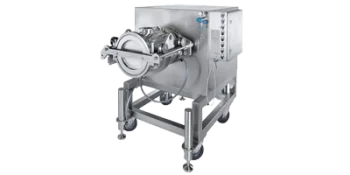
The Cyclomix high-shear mixer combines convective powder movement with impact and shear forces generated by its rotating mixing element. Mixing speed, processing time, filling level and the sequence of ingredient addition can be adjusted to suit the formulation. The conical mixing chamber and central discharge facilitate product emptying, while different feeding, discharge, control and cleaning configurations can be incorporated according to project requirements.
The Cyclomix can also be used for processes such as dry coating of carrier particles, depending on the formulation and the desired particle properties.
From formulation development to GMP production
The Mini Cyclomix laboratory mixer supports small-scale DPI formulation development, particularly when only limited quantities of API are available.
Interchangeable product bowls with volumes of 0.1, 1 and 2 litres provide flexibility for investigating the effects of:
- Mixing speed and processing time
- Filling level
- Order of ingredient addition
- API concentration
- Carrier particle properties
- Mixing energy and particle interactions
The Mini Cyclomix is also available with an optional GMP configuration for small-batch pharmaceutical production, including the manufacture of DPI formulations for clinical trials. This allows the same mixing technology to be considered for both formulation development and clinical batch manufacturing, subject to the applicable qualification, validation and GMP requirements.
For larger production requirements, Cyclomix mixers are available in different sizes and configurations. Scale-up requires consideration of mixing energy, particle behaviour and critical quality attributes rather than relying on batch volume alone.
Particle engineering and surface modification
Some DPI formulations may benefit from particle engineering techniques that modify surface properties or interactions between formulation components.
The Nobilta super-high-shear mixer can be considered for processes such as dry coating, surface modification and the formation of composite particles. Mechanofusion technology from Hosokawa Micron Corporation provides another approach to modifying particle surfaces and interactions through controlled mechanical energy.
These technologies may complement conventional blending during the development of specialised DPI formulations or functionalised excipients. Their suitability depends on the formulation, material sensitivity and required particle properties.
Containment and pharmaceutical integration
Micronised pharmaceutical ingredients may require controlled handling and containment, depending on their toxicity, occupational exposure limits and the operations involved. Milling, mixing, material transfer and discharge can be incorporated into contained processing arrangements, including isolators where required.
Depending on the application, an integrated system may address:
- Contained material feeding and transfer
- Sampling and product discharge
- Cleaning and decontamination
- Product recovery and minimisation of losses
- Prevention of cross-contamination
- Process monitoring and control
- Qualification and documentation requirements
Hosokawa Micron supplies integrated powder processing systems designed around the process and applicable pharmaceutical requirements.
Customer reference
Intech Biopharm uses a 5-litre Cyclomix high-shear mixer in its DPI production line to incorporate and distribute a small quantity of API within a substantially larger quantity of excipients.
Click here
Test before you invest
Run trials with your own materials on lab and production-scale equipment at our 2,000 m² test centre in the Netherlands. Our experienced process specialists work with you to determine the right process, equipment or system configuration for your DPI application. Each trial is supported by a detailed technical report, helping you select the right solution with confidence.
Learn more
Talk to our experts
Developing or scaling up a dry powder inhaler formulation? Our process specialists can help you identify suitable technologies for micronisation, blending, particle engineering and contained pharmaceutical processing.

Our process solutions




Sustainable process technologies
Hosokawa Micron B.V. is committed to sustainable and responsible process technology. Our environmental management system is certified to ISO 14001, while our EcoVadis Silver Medal places us among the top 3% of rated companies in the special-purpose machinery industry.
